

Drivers of electricity prices across households and energy-intensive industries and their importance for the EU’s decarbonisation objectives
Prepared by Daniela Arlia and John Hutchinson
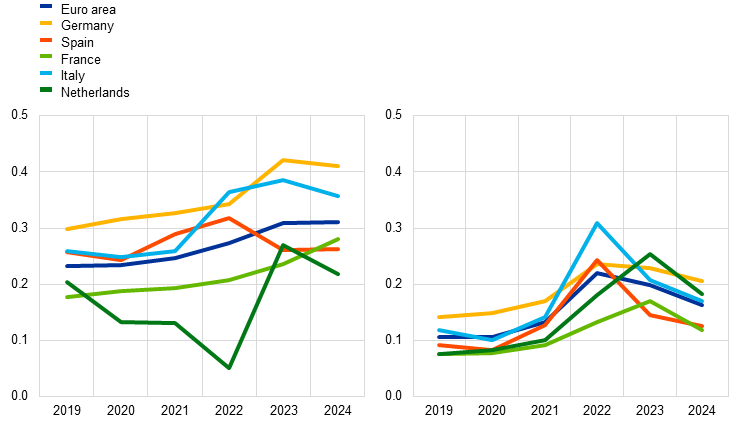
Electrification is central to the EU’s decarbonisation strategy, yet electricity demand has remained broadly stagnant over the past decade, with prices remaining elevated after the 2021-22 energy crisis (Chart A). The European Commission’s Clean Industrial Deal, launched in February 2025, aims to increase the share of electricity in the EU’s gross final energy consumption from 23% in 2024 to 32% by 2030. Since electricity can be more readily generated from renewable sources compared with other forms of energy, increasing its share in final energy consumption is central to achieving the targets set in the EU’s Renewable Energy Directive. However, reaching this consumption target could be challenging, as electricity consumption in the euro area decreased by 6.3% between 2015 and 2023 (Eurostat, 2026).[1] At the same time, electricity prices remain elevated compared with levels before the 2021-22 energy crisis, though there is substantial variation across EU Member States and between households and firms. High electricity prices directly affect households by reducing purchasing power, while also having an impact on the competitiveness of energy-intensive firms. This box examines the composition of energy prices, the factors driving price differences, as well as recent consumption patterns in the five largest euro area countries, focusing on households and energy-intensive industries.
Chart A
Annual electricity prices for households and energy-intensive industries
(EUR/kWh)
a) Households |
b) Energy-intensive industries |
|---|---|
 | |
Sources: Eurostat and ECB calculations.
Notes: Household electricity prices are calculated across all electricity consumption bands. Energy-intensive industries are categorised following the definition provided by Dechezleprêtre et al. (2025) and then matched with the relative consumption bands following the European Commission (Directorate-General for Energy, European Commission et al., 2025). These include (i) manufacture of wood, (ii) manufacture of paper and pulp, (iii) manufacture of coke and refined petroleum products, (iv) manufacture of chemicals and chemical products, (v) manufacture of rubber and plastic products, (vi) manufacture of other non-metallic mineral products, (vii) manufacture of basic precious and other non-ferrous metals, (viii) extraction of crude petroleum and natural gas, and (ix) mining of metal ores.
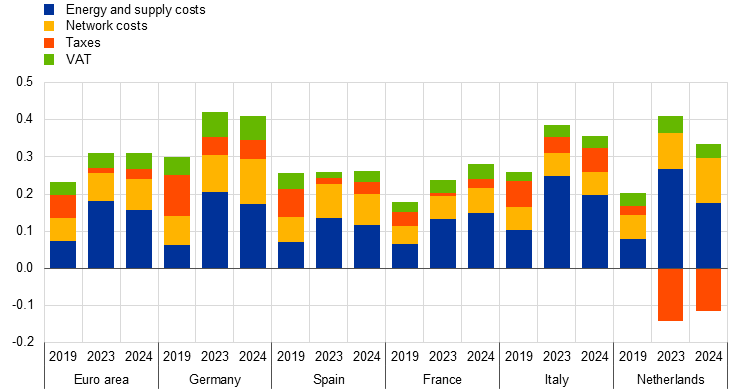
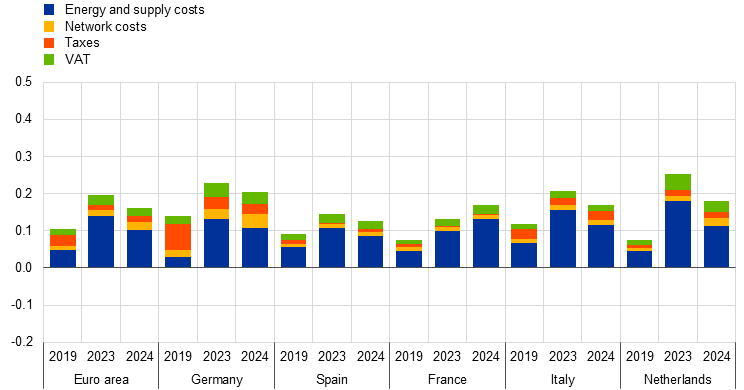
Energy and supply costs account for the largest share of the final electricity bill for both households and energy-intensive industries, with taxes and network costs also being significant contributors. Electricity prices for end users can be decomposed into four main components: (i) energy and supply costs, (ii) network costs, (iii) VAT, and (iv) other taxes.[2] The energy and supply cost component includes fuel costs and the cost of allowances under the EU’s Emissions Trading System (ETS). In 2024 energy and supply costs accounted for around 50% of the electricity bill for euro area households and 63% for energy-intensive industries. Network costs accounted for 27% of household bills but only 12% for those of energy-intensive industries, as larger industrial consumers – often directly connected to high or very high voltage grids – benefit from reduced network charges. VAT made up around 14% of the electricity bill for both households and firms in 2024, while other country-specific taxes and pricing schemes accounted for roughly 10%, contributing to cross-country variation (Chart B).
Chart B
Decomposition of electricity prices for households and energy-intensive industries
a) Households
(EUR/kWh)
b) Energy-intensive industries
(EUR/kWh)
Sources: Eurostat and ECB calculations.
Notes: Taxes include capacity, renewable, environmental, nuclear and all other taxes (i.e. taxes, fees, levies or charges not covered by any of the previous categories). Household electricity prices are calculated across all electricity consumption bands. Energy-intensive industries are categorised following the definition provided by Dechezleprêtre et al. (2025) and then matched with the relative consumption bands following the European Commission (Directorate-General for Energy, European Commission et al., 2025). These include (i) manufacture of wood, (ii) manufacture of paper and pulp, (iii) manufacture of coke and refined petroleum products, (iv) manufacture of chemicals and chemical products, (v) manufacture of rubber and plastic products, (vi) manufacture of other non-metallic mineral products, (vii) manufacture of basic precious and other non-ferrous metals, (viii) extraction of crude petroleum and natural gas, and (ix) mining of metal ores.
Euro area households pay around twice as much for electricity as energy-intensive industries, reflecting higher prices across all components of the electricity bill (Chart B). In France and the Netherlands, households pay approximately 64% and 20% more than energy-intensive industries. This is even more pronounced in Germany, Spain and Italy, where household electricity prices are around 100% higher. Countries that rely on imported fossil fuels for electricity generation tend to face higher electricity prices, since these are typically more expensive at the margin than nuclear or renewables. Additionally, differences in national taxes and regulation on network charges also account for considerable cross-country variation in final electricity prices.[3]
Electricity prices have increased more strongly for energy-intensive industries than for households since before the energy crisis (Chart B). Between 2019 and 2024 electricity prices increased by around 53% for energy-intensive industries and by around 33% for households. In both cases, these increases were mostly driven by higher costs of the underlying fuel types. In response to the energy crisis, compensation measures such as energy price caps were introduced to mitigate the effects on retail prices, which broadly benefited both households and firms.[4]
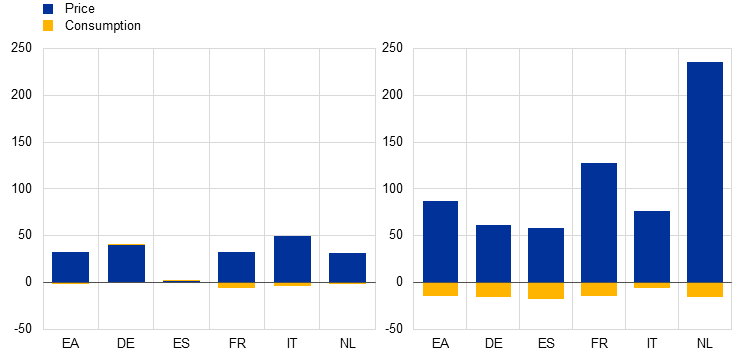
Higher electricity prices have significantly increased total expenditure for both households and energy-intensive industries, despite declining consumption, particularly among energy-intensive industries (Chart C). A decomposition of total electricity expenditure into prices and consumption reveals that the increase in electricity prices has driven the increase in expenditure. Between 2019 and 2023 electricity consumption by energy-intensive industries in the euro area declined by around 14.5%, while household electricity consumption fell by around 1.5%.[5]
Chart C
Total expenditure growth decomposition for households and energy-intensive industries
(percentage change between 2019 and 2023)
a) Households |
b) Energy-intensive industries |
|---|---|
 | |
Sources: Eurostat and ECB calculations.
Notes: Household electricity prices and consumption levels are calculated across all electricity consumption bands. Data for consumption are available only up to 2023. Energy-intensive industries are categorised following the definition provided by Dechezleprêtre et al. (2025) and then matched with the relative consumption bands following the European Commission (Directorate-General for Energy, European Commission et al., 2025). These include (i) manufacture of wood, (ii) manufacture of paper and pulp, (iii) manufacture of coke and refined petroleum products, (iv) manufacture of chemicals and chemical products, (v) manufacture of rubber and plastic products, (vi) manufacture of other non-metallic mineral products, (vii) manufacture of basic precious and other non-ferrous metals, (viii) extraction of crude petroleum and natural gas, and (ix) mining of metal ores.
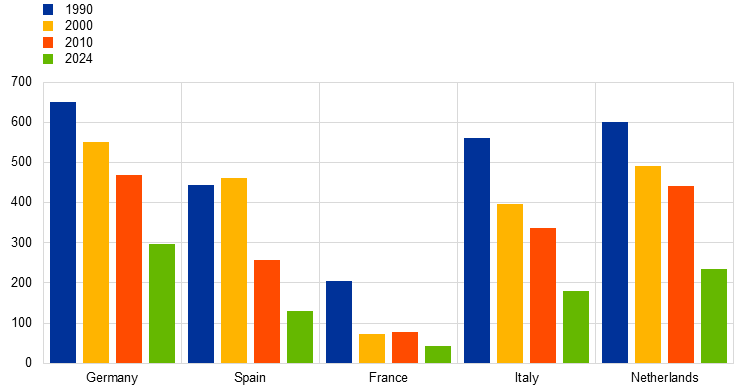
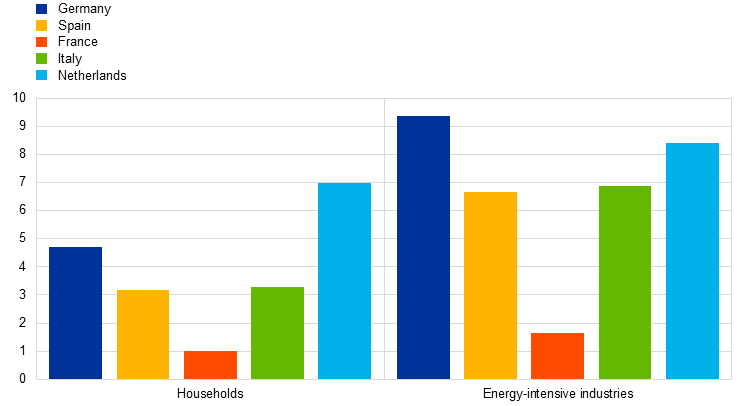
The impact of ETS costs on electricity prices is less significant in countries with less carbon-intensive electricity generation (Chart D). Carbon intensity has declined markedly as countries have shifted from coal towards cleaner fuel types and, since 2010, towards renewables (European Environment Agency, 2025).[6] France has the lowest greenhouse gas emission intensity of electricity generation, owing to its long-standing reliance on nuclear power. In contrast, countries with a relatively high carbon intensity experience greater cost pressures from the ETS, with its contribution to the price of electricity reaching up to 9%.[7] This share tends to be higher for energy-intensive firms, as energy and supply costs account for a larger proportion of their electricity bill.
Chart D
Greenhouse gas emission intensity and ETS costs across countries
a) Greenhouse gas emission intensity over time
(gCO2e/kWh)
b) Share of ETS costs in overall price of electricity in 2024
(percentage values)
Sources: Eurostat, European Environment Agency and ECB calculations.
Notes: ETS costs across countries have been calculated using ETS prices in 2024 (€65 per tonne of CO2) multiplied by the amount of greenhouse gas emissions per kW of electricity in the same year in each country. These values have been used to calculate the relative share of ETS costs in the overall electricity price for households and energy-intensive industries in each country.
In sum, achieving the EU’s decarbonisation objectives depends on meeting its electrification targets, which can be facilitated by lower electricity prices. Electricity price differences across euro area countries stem from differences in energy mixes, with countries relying more on imported fossil fuels for electricity generation tending to face higher prices.[8] Additional factors contributing to cross-country disparities include limited interconnectivity between markets, national taxes, policy choices and regulation of network costs. While short-term relief measures such as price caps and tax reductions can ease price pressures, these do not address the underlying drivers of high electricity prices. These measures should be devised so as not to weaken incentives for energy-intensive industries to decarbonise. To this end, the European Commission’s Action Plan for Affordable Energy combines immediate relief measures with structural measures to reduce electricity prices. Additionally, the recently announced European Grids Package and the Energy Highways initiative should expand and modernise Europe’s energy infrastructure.[9] Ultimately, ensuring affordable, secure and sustainable energy is central to the EU’s decarbonisation strategy and its long-term economic resilience (Parker et al., 2026; Lagarde, 2025).
References
Dechezleprêtre, A., Dernis, H., Díaz, L., Lalanne, G., Sancho, S.R. and Samek, L. (2025), “A comprehensive overview of the Energy Intensive Industries ecosystem”, OECD Science, Technology and Industry Working Papers, No. 2025/09.
De Sanctis, A., Grynberg, C and Vinci, F.R. (forthcoming), “The European Energy Landscape and Industrial Competitiveness: Making the Case for an Energy Union”, Occasional Paper Series, ECB.
Directorate-General for Energy, European Commission, E3-Modelling, Enerdata, Ludwig-Bölkow-Systemtechnik, Öko-Institut and Trinomics (2025), Study on energy prices and costs: evaluating impacts on households and industry – 2024 edition.
European Environment Agency (2025), Greenhouse gas emission intensity of electricity generation in Europe, 6 November.
Ferdinandusse, M. and Delgado-Téllez, M. (2024), “Fiscal policy measures in response to the energy and inflation shock and climate change”, Economic Bulletin, Issue 1, ECB.
Heussaff, C. (2024) “Decarbonising for competitiveness: four ways to reduce European energy prices”, Policy Brief 32/2024, Bruegel, 5 December.
Heussaff, C., Jüngling, E., Tagliapietra, S. and Zachmann, G. (2025) “Who should be charged? Principles for fair allocation of electricity system costs”, Policy Brief 16/2025, Bruegel, 24 April.
International Energy Agency (2024), World Energy Outlook 2024, 16 October.
Kuik, F., Adolfsen, J.F., Lis, E.M. and Meyler A. (2022), “Energy price developments in and out of the COVID-19 pandemic – from commodity prices to consumer prices”, Economic Bulletin, Issue 4, ECB.
Lagarde, C. (2025), “Europe’s road to renewables”, speech at Norges Bank’s Climate Conference, Oslo, 21 October.
McKinsey (2024), Electricity demand in Europe: Growing or going?, 24 October.
Navia, D. and Diaz Anadon, L. (2025), “Power price stability and the insurance value of renewable technologies”, Nature Energy, Vol. 10, 28 January, pp. 329-341.
Parker, M. and Parraga Rodriguez, S. (forthcoming), “Overcoming structural barriers to the green transition”, Economic Bulletin, Issue 1, ECB.
Legal Disclaimer:
EIN Presswire provides this news content "as is" without warranty of any kind. We do not accept any responsibility or liability for the accuracy, content, images, videos, licenses, completeness, legality, or reliability of the information contained in this article. If you have any complaints or copyright issues related to this article, kindly contact the author above.
